Jurong Line: Is this Goodbye?
By Daphne, 22 Feb 2011.
It was close to 20 years ago when the last train went down the tracks of the Jurong Line of the KTM Malayan Railway in Singapore. These tracks, which run from the Jurong Industrial park to Bukit Timah, has since been dismantled in part, but mostly left abandoned.
In May 2010, news that Tanjong Pagar Train Station, the only remaining train station part of the KTM Malayan Railway Network that still functions in Singapore, was going to move north to Woodlands broke out. The KTM Malayan Railway has for years brought people and goods from Malaysia to Singapore and vice versa. Since then, there has been speculation as to what would happen to these railway tracks – both the line that runs from Tanjong Pagar to Woodlands, and the Jurong Line.
I took a walk down the Jurong Line, two Sundays ago, and to my dismay, work on removing these tracks had already started.
I had began my walk from Penjuru Road, near the Teban Gardens estate in Jurong, and was wondering why I could not spot any semblance of the tracks – I was even starting to think that I was not going down the right path. Read more
Jurong Line: A Photo Guide
By Daphne, 22 Feb 2011.
Want to walk the Jurong Line, the abandoned railway that is part of the KTM Malayan Railway Network and not quite sure how to? Here’s a photo guide that will show you how:
View KTM Malayan Railway Lines in Singapore in a larger map
From Penjuru Road to the Tunnel, along the Teban Gardens Estate

Entering the path from Penjuru Road, you will likely to be greeted by a dirt path. The dirt path that you see here is caused by some machinery that has already started digging up the tracks around this area. A stream, or perhaps you might refer to it as a drain, runs along the side of this path. On the opposite side of this stream lie some kampung (villages). Read more
Jurong Line: Kampung Life Along The Tracks
May 4, 2011 by admin
Filed under Heritage, Recreation, Stories
By Daphne, 22 Feb 2011.
Over the years, several enclaves developed by the side of the Jurong Line, part of the KTM Malayan Railway Network. These enclaves, termed as kampung (“village†in the Malay language) for the way it resembles – rural, simple, just like a village would look -, consist of small plantations, temples and sometimes even makeshift houses.
It seems, however, as if no one actually live in these kampung, but are instead “owned†and maintained by the residents who live in the neighbouring blocks.
In perpetually developing Singapore, it is inevitable that old things and places will give way to the new. Yet, I’m fairly certain that these kampung were very likely only “built†after the train tracks were abandoned, meaning that they are each less than 20 years old. In light of the fact that most kampung in Singapore were eradicated some 40 odd years ago, these little bits of village life almost appear like an anachronism, inconsistent with today’s life in Singapore. Read more
Red Dragonflies Movie Outing [5 May]
Time: Thursday May 5, 7:40pm – 9:15pm.
Location: Iluma Bugis.
We are organising an outing to watch the award-winning local film, Red Dragonflies, which opens this Thursday at Iluma Bugis. The film is shot partly at the old Jurong Line.
Pls buy your own tickets online at http://www.filmgarde.com.sg/detail.aspx?ID=212.
Duration: 96 mins
Director: Liao Jiekai
Cast: Ng Xuan Ming, Jason Hui, Thow Xin Wei, Oon Yee Jeng, Yeo Shang Xuan, Ong Kuan Loong, Chen Mei Guang, Haruka Ashida
Synopsis:
Rachel and her two friends explore an abandoned railway track that runs through a dense forest, but an unforeseen incident brings their little adventure to an abrupt end. Elsewhere, 26-year-old Rachel rekindles an old friendship with a high school friend. When a little boy from her past reappears, Rachel finds herself retracing a trail of iron and wood. Wistful and mysterious, the film depicts a world littered with incongruity, absences and traces of childhood dreams.
Watch the trailer at http://youtu.be/SBGzwQxISls. More info at http://www.reddragonflies.sg/.
Pls buy your own tickets online at http://www.filmgarde.com.sg/detail.aspx?ID=212.
Do support this local movie and see you there!
Familiarisation walk on the Jurong Line (only for volunteers) [22 Apr]
Time: Friday, April 22, 3 – 6pm
Location: Teban Gardens to Sunset Way
Hang Chong from the Nature Society (Singapore) is conducting a special familiarisation trip along the old Jurong Line to train volunteers who are willing to help us lead future walks at the Jurong Line.
Date and Time: Friday, April 22, 3-6pm (Good Friday and Earth Day)
Meeting time: 3pm
Meeting point: Blk 39A Food Centre, Teban Gardens Road (you can take bus 79 or 143 at Jurong East Interchange)
The Jurong Line, completed in 1965, served as an extension into the then newly constructed Jurong Industrial Estate. It failed to generate adequate traffic and was closed in the early 1990s. It has since been partially dismantled.
Be a volunteer and join us for this walk and explore natural reforestation, spontaneous gardens and small scale farming, walk in a dark underpass, and cross the Ulu Pandan Canal via a majestic cast iron bridge. Be prepared to get your shoes wet and muddy.
Sign up through the Facebook event page at http://www.facebook.com/event.php?eid=202596733105556 or indicate your interest in the comments section below.
Different routes for two railway stations?
By S Ramesh and Hetty Musfirah Abdul Khamid, Apr 09, 2011.
One could become the centrepiece of the glitzy redevelopment of the Tanjong Pagar area, while the other, an endearing local landmark in Bukit Timah, will stand as a piece of Singapore’s transport history.
The Preservation of Monuments Board (PMB) is gazetting the Tanjong Pagar Railway Station (TPRS) as a national monument, while the Urban Redevelopment Authority (URA) is gazetting the Bukit Timah Railway Station (BTRS) as a conserved building.
This, in view of “their deep historical significance, and to protect physical reminders of our rich heritage”, according to a joint statement from the PMB and URA released on Friday.
Source: Today Online
Historic railway stations to be kept for future generations
In view of their deep historical significance and to protect physical reminders of our rich heritage, the Singapore government will be keeping both the Tanjong Pagar Railway Station and the Bukit Timah Railway Station. The Preservation of Monuments Board (PMB) is gazetting the Tanjong Pagar Railway Station as a National Monument, while the Urban Redevelopment Authority (URA) is gazetting the Bukit Timah Railway Station as a conserved building.
At their Retreat on 24 May 2010, the Prime Ministers of Singapore and Malaysia announced in their Joint Statement that the Keretapi Tanah Melayu Berhad (KTMB) station would be relocated from Tanjong Pagar to the Woodlands Train Checkpoint (WTCP) by 1 July 2011. Both Leaders also agreed that the Tanjong Pagar Railway Station Passenger Terminal building would be conserved given its historical significance and the old Bukit Timah Railway Station building at Blackmore Drive could also be conserved.
With the relocation of KTMB station from Tanjong Pagar to WTCP by 1 July 2011, both the Tanjong Pagar Railway Station and the Bukit Timah Railway Station will then cease to operate as KTMB railway facilities. Read more
A colourful journey in black and white
By Jerome Lim, 14 March 2011.
I have always been one for train rides, taking one every opportunity I get whenever I find myself with time to spare, be it from the grand stations of the great European cities, or from stations closer to home, with a particular liking for the old style railways that I sometimes stumble upon. In Singapore, the opportunity had presented itself throughout my life I guess, but somehow, I never embarked on a journey from the grand old station at Tanjong Pagar until I was well into my adulthood, making many trips in the 1990s. Trains always present themselves as a convenient means to get around from one city to another, taking one from the centre of the city right into the heart of another. So it is with the Malayan Railway as well – for another few months at least when Keretapi Tanah Melayu Berhad (KTMB or KTM) moves the terminal station from Tanjong Pagar to Woodlands. With that, we will bid goodbye to the old railway lines which has served Singapore since the turn of the last century, as well as an old railway station in the heart of the city.

The last opportunity to take a train from an old style station in the heart of Singapore, on a line that has served Singapore since 1932 (parts of it date back to the turn of the last century), through Singapore’s countryside, before train services terminate at Woodlands by the time the 1st of July arrives.
As mentioned in my previous post, I took another ride recently, just for the sake of reliving my previous journeys before the chance to do so evaporates once KTM moves operations to Woodlands. It will be a shame not to have had that experience, one that involves arriving or departing from the platforms which had served as the southern terminal to the Malayan Railway for eight decades from its days as the FMSR. Once the move is made, Singapore would lose not just another historical link it has had with the Malay States in the Malayan Peninsula, but also a proper train station to take a romantic journey on a train from. What will also go are the well worn tracks that served us so well, laid over a corridor of land that probably due to the railway, has remained untouched and relatively green; as well as the many markers left behind by the railway including the railway bridges, signal posts, railway buildings and control huts, distance markers and the last remaining level crossings in Singapore. Read more
There I go again … another journey through Tanjong Pagar
By Jerome Lim, 11 March 2011.
I guess I have not had enough of it, despite probably having tens of, if not a couple of hundred journeys out of Tanjong Pagar. I did it once again, since proclaiming that that journey taken with some friends at the end of last year would possibly have been my last. Having had a mixed bag of experiences on the many journeys through the arches of the grand old station, the ones that probably I remember most of are the regular delays that one comes to expect on the far from reliable train service that KTMB operates. Part of the reason for this, some of the archaic infrastructure and practices still in use on the old railway, does perhaps lend itself to an experience that you would certainly not get on the efficient railways that criss-cross much of the European continent – one that seems out of place in the ultra modern and efficient world we have grown accustomed to in Singapore.
I will certainly miss taking train journeys out of Tanjong Pagar … something that will perhaps motivate me to take a few more over the next few months before the station closes.
Stepping into the station itself would somehow take you back in time, the atmosphere being one which seems more at home in the Singapore of the 1960s and 1970s. The large airy concourse that greets the visitor is adorned with mosaic murals that speak of a style that was prevalent of a time we have left behind and depict scenes from the Malayan peninsula that would have been more common in that era. Over the years that I had have an awareness of the layout of the concourse, nothing much has changed except perhaps that the occupants of some of the spaces, and an invasion of a Tourism Malaysia hut in the middle of it. It is in one of the spaces along the concourse that some nice food can be found and to perhaps add a old world flavour to the station, you would find food vendors that would be more comfortable conversing in Bahasa Melayu, once a common language on the streets. Read more
Journeys through Tanjong Pagar: First Impressions …
By Jerome Lim, 21 Sep 2010.
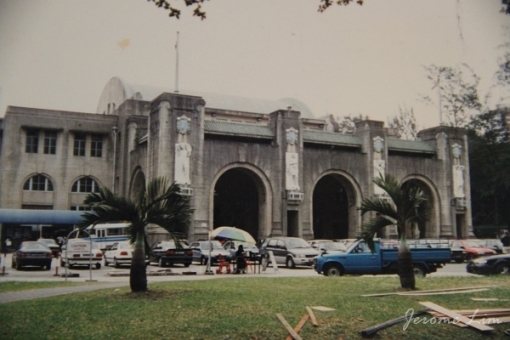
I had as a child, been fascinated by the old railway station at Tanjong Pagar. The grand old station building, which has provided many of us with a passage to the north, had been one that always attracted my attention whenever I passed it in the backseat of my father’s car. The very first impression I have of the station is one that has been shaped by the food stalls that sprouted up in the open air car park in front of the station every evening, stalls that seemed to glow in the shadows cast by the grey façade of the railway station.